

A physiologist in Paris
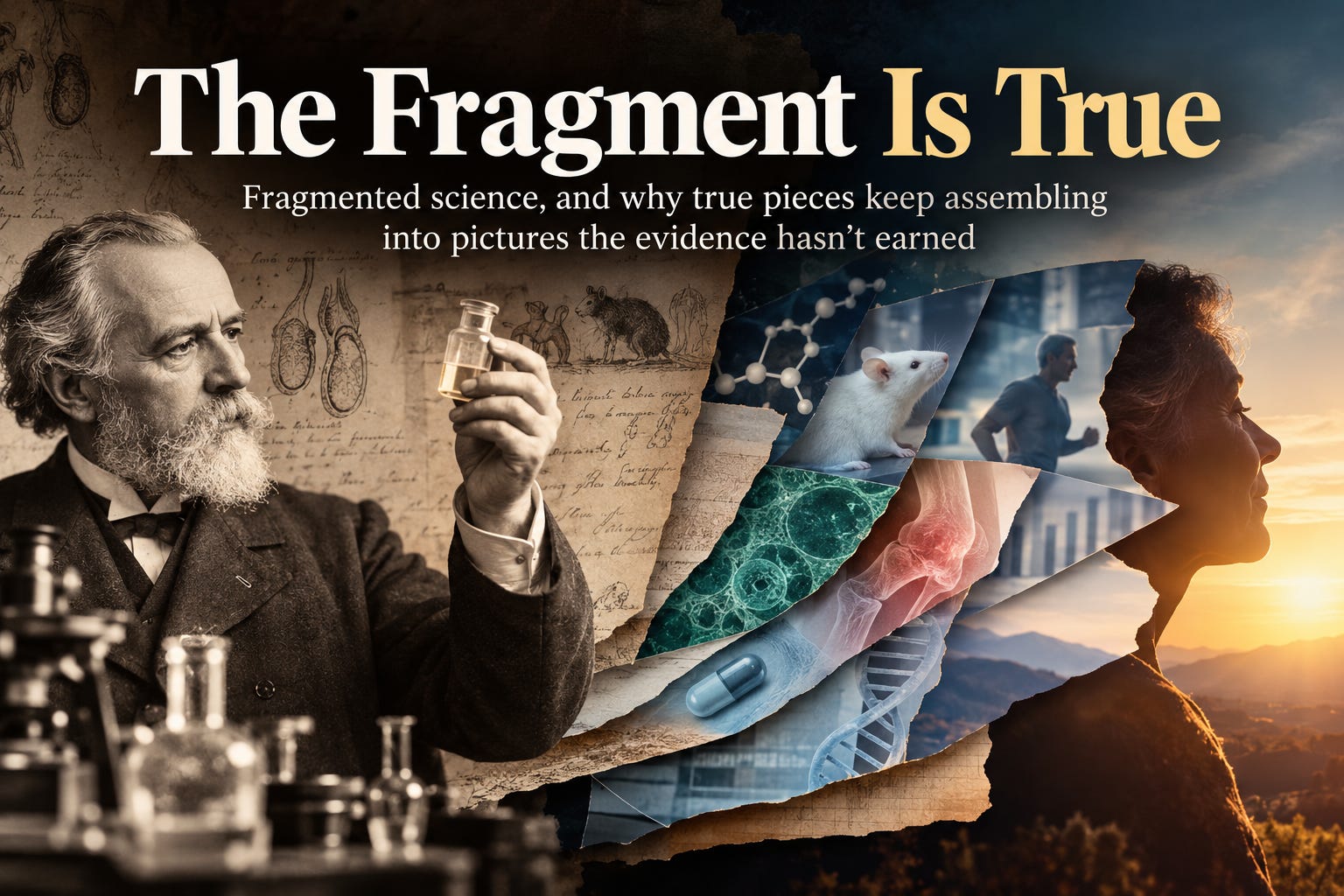
On June 1, 1889, a 72-year-old physician named Charles-Édouard Brown-Séquard addressed the Société de Biologie in Paris and described an experiment he had been running on himself. Over the preceding weeks he had injected a liquid made from the testicles of dogs and guinea pigs. He said he felt stronger. He could work longer without fatigue. Vigor he had assumed was gone for good had returned. He even reported an improvement in his urinary stream.
It would be convenient if he were a charlatan. He was not.
Brown-Séquard was one of the most accomplished experimental physiologists of his century. He had held a professorship at Harvard, and medical textbooks still name a pattern of spinal cord injury after him. His reasoning had a sensible shape. Castration visibly changed animals, so something produced in the testes seemed to matter for vitality. If that something declined with age, perhaps it could be put back.
The announcement traveled fast. Testicular extracts came into wide use across Europe and North America and stayed in use for decades. No one in 1889 could know that testosterone would not be isolated until 1935, or that an extract made his way would contain very little of it. In 2002, Australian researchers reproduced his preparation. They found testosterone concentrations roughly ten thousand times lower than a biological effect would require. Whatever produced the improvement Brown-Séquard reported, the testosterone in his preparation was far too little to explain it.
Here is the part the story usually leaves out.
Brown-Séquard was wrong about his extract and right about the idea underneath it. Glands really do secrete substances that govern the body. Two years after his lecture, a British physician named George Murray treated a woman with severe hypothyroidism using an extract of sheep thyroid, and she lived for decades afterward. The same enthusiasm that produced a mistaken extract also produced one of the first effective hormone therapies. Endocrinology grew up in that mixed soil.
So the lesson of Brown-Séquard is not “ignore the new thing.” It is more precise than that, and more uncomfortable.
His observation of himself was real. The biology he was reaching for was real.
The conclusion he drew from one aging body over a few weeks was not earned.
The shape repeats
Change the century and the vocabulary, and the same shape appears again.
In 1990 the New England Journal of Medicine published a small study by Daniel Rudman and colleagues. Twelve men between 61 and 81 received human growth hormone for six months, and nine similar men did not. The treated men gained lean mass and lost fat. The paper said nothing about lifespan, and an accompanying editorial urged caution. That caution did not survive the trip into the world, and growth hormone became a fixture of anti-aging clinics.
In 2007, Stanford researchers pooled the randomized trials of growth hormone in healthy older adults. They found small changes in body composition, little else that improved, and higher rates of side effects such as swelling, joint pain, and carpal tunnel syndrome.
The original finding held up reasonably well. It had simply never been a finding about aging well.
In 2003 a Harvard laboratory reported in Nature that resveratrol activated SIRT1 and extended lifespan in yeast. A company built on sirtuin activation was acquired by GlaxoSmithKline in 2008 for roughly $720 million. Then other laboratories, including groups at Amgen and Pfizer, reported that the apparent activation depended on a fluorescent tag used in the lab test and disappeared with natural substrates.
A trial of the company’s resveratrol formulation in multiple myeloma was halted after several patients developed kidney failure. GSK’s own analysis attributed the kidney failure most likely to the disease itself, with the drug’s poor tolerability possibly contributing, and found the formulation offered minimal efficacy. In 2013, GSK closed the company’s Cambridge site and folded its sirtuin research into its own labs.
Even this story refuses a clean ending.
In 2013 the original lab and collaborators published evidence of a genuine activation mechanism that works with certain natural substrates. Whether sirtuin activators meaningfully benefit human aging remains an open question.
The mechanism was not simply debunked. It was far less settled than the valuation implied.
Before either of these came grafts of primate testicular tissue in the 1920s and injections of animal embryo cells at Swiss clinics in the decades after.
The costumes change. The structure stays recognizable.
Naming the gap
What these episodes share deserves a name, because the name makes the pattern easier to see.
Call it fragmented science: real findings, real mechanisms, and real peer-reviewed results, separated from the context that made them reliable and assembled into conclusions the complete evidence has not reached.
The fragment is true. The conclusion is unearned.
Fragmented science is not fraud, and that is what makes it durable.
You can expose fraud by checking whether the study exists. Fragmented science passes that check because the study does exist. Its weakness sits somewhere else, in the joints between the pieces.
It helps to notice that claims about aging sit on different rungs of a ladder, and each rung makes a different kind of statement.
Basic biology. At the bottom, aging has identifiable mechanisms, and geroscience studies them. The widely cited Hallmarks of Aging framework is a real organizing achievement of this work.
Plausible hypotheses. If a mechanism drives decline, intervening on it might help.
Preliminary evidence. Cells, yeast, worms, mice, small human studies without controls, and shifts in biomarkers.
Established clinical outcomes. Randomized human trials showing that people lived longer, functioned better, or suffered less.
Off to the side of the ladder sits the commercial claim, which can borrow language from any rung.
Each rung is legitimate. Much important science happens on the lower ones, and it should.
Fragmented science is what happens when a statement earned on one rung gets spent on another.
A mouse result is described in the grammar of a clinical outcome. A biomarker change is described as though the person has become younger. A mechanism is described as though it were already a treatment.
A contemporary composite
The modern version rarely looks like monkey glands. It looks careful.
Picture an article from a company that sells personalized peptide protocols.
It opens with a famous athlete who traveled abroad for stem cell injections. It explains, accurately, that mesenchymal stem cells seem to help tissue mainly through the signals they release rather than by turning into new tissue. Some of the field’s founders have argued this for years. It cites real trials of stem cell injections for knee cartilage, with real journal references. It even concedes that these therapies are largely investigational, and that the peptide it promotes has no completed controlled efficacy trials in humans.
Then it builds a bridge.
Stem cells heal through signaling. Peptides are signals. Your genes shape how you respond to signals. Software can model your genes.
Therefore, you need a personalized peptide plan.
Every plank is made of something real.
The bridge reaches farther than the evidence does.
The cartilage trials concern knees, not aging. For one popular peptide, BPC-157, a 2025 systematic review found 36 relevant studies. Thirty-five were preclinical, and the single human report was a small retrospective case series with no control group.
Genetics really does influence how people respond to drugs, but findings about specific drugs do not transfer to a protocol no trial has tested.
The company goes unnamed here because it isn’t the point. Dozens of pages could stand in for it.
David Deutsch offers the most useful test I know for this situation. A good explanation, he argues, is hard to vary. Its details do real work, so changing any of them breaks the account. A bad explanation is easy to vary. Its details can be swapped without consequence, which means they were never explaining anything.
Run the test.
The signaling account of stem cells is fairly hard to vary. Take away signaling and you lose the explanation for why cells that don’t persist in tissue still seem to have effects.
Now try the commercial bridge.
Replace “peptides” with another signaling molecule, “genes” with the microbiome, “software model” with a blood panel, and “regeneration” with “longevity.”
The argument reads just as smoothly.
When the parts can be swapped that freely without the conclusion wobbling, the parts are not load-bearing.
The science supplies texture.
Whatever is holding the conclusion up, the evidence is not carrying it.
Nobody has to lie
The obvious next move would be to find a villain.
It would also be the wrong move, because the pattern does not need one.
Follow a finding through the system.
The researcher needs publications and grants, and a striking result in mice is a real result worth reporting.
The journal serves its readers by publishing novel findings, and novelty can be especially visible on the lower rungs.
The university press office wants its institution’s work noticed, and may write a release that leans toward significance. A 2014 study in the BMJ examined health press releases from UK universities. It found that roughly a third or more contained claims stronger than the papers they described. When releases exaggerated, news stories were much more likely to exaggerate too.
The journalist needs a headline someone will click.
The investor needs a large market and a plausible mechanism, and aging supplies both.
The clinician faces patients who ask about what they read, and wants to offer something better than “wait for more data.”
The marketer needs a claim that survives legal review, which means a claim that points at real studies.
The consumer wants some control over a process that otherwise feels like it is simply happening to them.
Each of these responses is reasonable on its own terms.
Each handoff can shed a little qualification.
“In mice” becomes “in animals,” then “in studies,” then “science shows.”
Individuals do sometimes exaggerate, and occasionally worse, but the pattern does not depend on it. Nobody at any single step has to say anything false.
The distortion can emerge from the chain.
The chain also feeds itself.
Consumer interest attracts investors, and investors fund companies. Companies have reason to value research that can produce promising results relatively quickly, and findings from the lower rungs can enter the market conversation long before decisive human evidence arrives.
The correcting forces are real too: replication, randomized trials, regulators. But they often run on a slower clock.
A mouse study can reach a headline in a week. A decisive human trial of an aging intervention may take years, and in some cases a decade or more, if anyone pays for it.
In the space between those two clocks, the fragment can do its commercial work.
So the useful question is not “who is lying?”
It is:
What loop is producing this outcome, and where in it am I standing?
Where I am standing
I would rather not answer that last question, which is usually a sign it deserves an answer.
For years I wanted to be a centenarian.
I still do, in a humbler form.
I have read the nutrition wars, the training literature, and the biology of aging. I coach people on their health, and I write about it for readers who trust me to have done the reading. I understand the pull from the inside because the pull is mine.
It is the hope that the right food, sleep, training, and numbers on the right panel might buy a few more clear years.
That means I am not outside the loop I just described.
I am a link in it.
When I pass a finding to a client or a reader, I am one of the handoffs where qualification can quietly fall away. The line between a gullible public and a discerning observer flatters the observer, and I don’t get to stand on the observer’s side of it.
This summer made that concrete.
After a day of packing for a move, I spent several days in a hospital bed, and imaging showed significant degeneration in my right hip. I had been training consistently. I had run a 5K two days earlier.
What I learned was not why it happened.
It was that the health markers I watched most closely had shown me nothing about it.
I don’t draw a grand lesson from one body’s surprise. That would be Brown-Séquard’s mistake in reverse. But it corrected an assumption I hadn’t noticed I held: that enough information about the right fragments adds up to a picture of the whole.
What the years are for
It is easy to make the history of longevity look silly.
Mockery ends the inquiry too early.
The wish for more time is not vanity or laziness. It may be closer to grief, a grief that arrives in advance, for a life we would like to keep living.
A desire that deep will reach for any credible-sounding help.
And fragments are the most credible-sounding help there is, because they are true.
This is where the loop I described earlier meets a second one.
A system that keeps producing promising fragments meets a person who keeps hoping for more time, and each makes the other easier to sustain.
I am standing where they meet.
Erich Fromm distinguished between having and being. I find it useful as a question to put to myself.
When I want more years, do I want more of something to possess, or more room to live the way I would want to live anyway?
The answer settles no scientific question.
It does change how hungry I am for fragments, and hunger is what makes an unearned conclusion easy to swallow.
Fallibility cuts both ways
None of this means aging research is futile, or that longevity scientists are selling snake oil.
That would be its own unearned conclusion, built from a few vivid failures.
The evidence in this field is genuinely mixed, and mixed evidence deserves to be described as mixed.
Rapamycin extends lifespan in mice as consistently as almost any drug tested. PEARL, a small randomized human trial of low-dose rapamycin, found no change in visceral fat, its primary endpoint. Women on the higher dose gained lean tissue and reported less pain.
That is not “rapamycin failed in humans,” and it is not “rapamycin works in humans.”
It is a result that shows us what we still don’t know.
Senolytic drugs, which clear aging cells, looked dramatic in mice. One company’s knee osteoarthritis candidate showed no benefit over placebo. Its eye disease candidate did better. In a later trial it produced vision gains comparable to standard treatment and met the non-inferiority test at nine of ten time points, narrowly missing the one the trial had specified as primary. The company dissolved in 2025.
The underlying hypothesis about cellular senescence remains one of the most active in aging biology.
A drug and a hypothesis are different things.
Meanwhile, a first-in-human Phase 1 trial of ER-100 partial epigenetic reprogramming is under way in patients with optic nerve disease. The trial is designed primarily to assess safety and tolerability.
Not long ago the idea sounded like science fiction.
Some of today’s speculative interventions will become tomorrow’s medicine, just as thyroid extract did.
Premature belief is an error.
Premature dismissal is also an error.
The cynic who says “it’s all hype” and the enthusiast who says “the science is in” make the same move from opposite ends:
They let a fragment decide.
A different reflex
There is no need to end this with rules.
The pattern is easier to see than to legislate.
What changes, once you have seen it, is the reflex.
“A study shows” used to arrive for me as a small verdict.
Now it arrives as a small puzzle.
What exactly did the study show?
In whom, over how long, and measuring what?
What did someone who didn’t run it infer from it?
What had been added by the time it reached me?
Often the answers are reassuring, and the fragment and the conclusion fit together well.
Sometimes they don’t, and the gap between them is where something is being sold.
Brown-Séquard stood in Paris and believed what he felt.
He was a careful man and a real scientist, pursuing a real idea that would one day become real medicine.
What he lacked was sufficient evidence, and sufficient distance from his own hope.
Most of us know something about that problem.
The fragments keep arriving, each one true.
The harder skill is noticing how quickly they start to look like a picture.
Sources and further reading
For readers who want to examine the evidence behind this essay, these are some of the principal sources I used. I have tried throughout to distinguish established findings from preliminary evidence and to describe mixed evidence as mixed.
Rudman et al., “Effects of Human Growth Hormone in Men over 60 Years Old,” New England Journal of Medicine (1990)
Liu et al., “Systematic Review: The Safety and Efficacy of Growth Hormone in the Healthy Elderly,” Annals of Internal Medicine (2007)
Howitz et al., “Small molecule activators of sirtuins extend Saccharomyces cerevisiae lifespan,” Nature (2003)
Hubbard et al., “Evidence for a Common Mechanism of SIRT1 Regulation by Allosteric Activators,” Science (2013)
Sumner et al., “The association between exaggeration in health related science news and academic press releases,” BMJ (2014)
Vasireddi et al., “Emerging Use of BPC-157 in Orthopaedic Sports Medicine: A Systematic Review,” HSS Journal (2025)
Moel et al., “Influence of rapamycin on safety and healthspan metrics after one year: PEARL trial results,” Aging (2025)
ER-100 Phase 1 trial, ClinicalTrials.gov